Financial Identity in Marriage: Thirty Two Years in His Name
Financial Identity, Women & Money, Faith, Marriage
Thirty Two Years in His Name: What One Intake Form Taught Tanya About Financial Identity
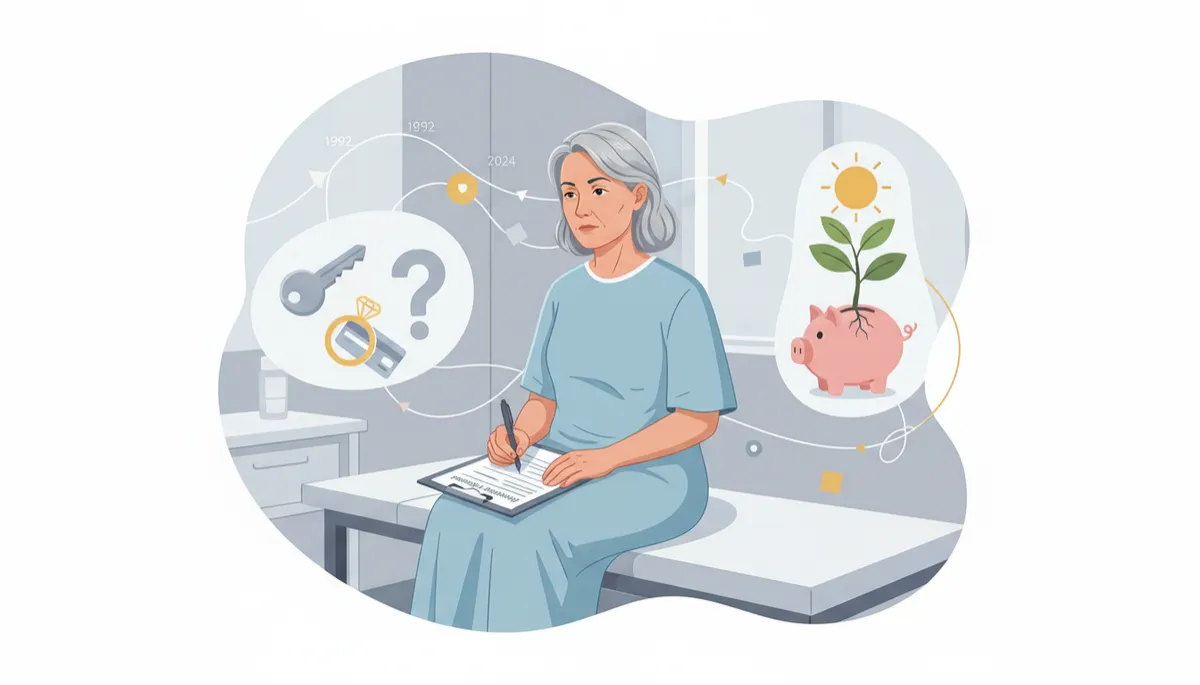
Tanya is sitting in a small exam room in a paper gown, staring at a stack of intake forms on a clipboard, and she's stuck on question fourteen: "List all accounts, credit cards, and loans currently held in your name." She's fifty four years old. She's been married thirty two years. And she is staring at a blank line because she genuinely does not know the answer.
Twenty minutes earlier, a doctor had said the word "biopsy." Now she's sitting with a different kind of shock, smaller, quieter, and somehow just as disorienting: in thirty two years of marriage, she has never once had a credit card, a loan, or an account that was only hers.
Tanya told me she sat there and thought: if something happens to Robert, or if something happens to us, I am fifty four years old, and I would be starting completely from zero. Tanya and Robert are a composite of stories I've walked alongside, with identifying details changed.
I'll tell you up front, this story isn't really about the diagnosis. Tanya's turned out to be good news. Caught early, good prognosis. This is about the second thing she found, hiding inside the first. And it's a truth I think a lot of women carry quietly for decades without ever naming it out loud.

When One Question Changes Everything
Facing your financial identity in the middle of a health scare
Thirty Two Years of Default
Tanya got married at twenty two. Robert handled the finances from the very beginning, not because Tanya wasn't capable, and not because anyone sat down and decided it that way. It just happened, the way a lot of things happen in a young marriage. He was good with numbers. She was pregnant within the first year. It made sense at the time, and it kept making sense, one ordinary year after another, for three decades.
The Invisible Labor and the Accounts in One Name
Tanya raised three kids and never went back to work outside the home after the first was born. She ran the household completely, but every account, every mortgage, every card was in Robert's name, or joint but managed entirely by Robert. She never questioned it, because it worked. Because there was trust. Because that's just how it was done in both of their families growing up.
This Isn't a Story About a Controlling Husband
Here's what I want you to understand: Robert wasn't hiding anything from Tanya, and he wasn't keeping her out on purpose. This is quieter and, in some ways, more common than that. It's thirty two years of nobody deciding anything, which is its own kind of decision.
The Fear Wasn't About Her Kids
Her kids are grown now, all three, out of the house, building their own lives. So this isn't a story about teaching children financial literacy. Tanya's fear isn't about what her kids don't know yet. It's about what she never built, and the quiet dread of becoming, someday, the kind of burden to her grown children that she watched her own mother slowly become to her.
Question Fourteen
Tanya was there for a routine mammogram that turned into a callback, then a biopsy. Twenty minutes after hearing that word, a nurse handed her a clipboard of intake forms to fill out while she waited for results. Insurance information. Emergency contacts. Financial responsibility forms.
And then question fourteen. Tanya sat with the pen hovering over the blank line for what felt like a full minute, running through account after account in her head, and coming up with the same answer every time: Robert's name. Joint, but Robert's name first. Robert's name.

When Two Fears Got Tangled Together
The diagnosis fear and this fear got tangled together in a way she didn't expect. It wasn't logical. The biopsy result had nothing to do with whose name was on a credit card. But sitting there, facing the possibility that something serious was happening to her body, she suddenly saw with total clarity how little of her life outside that body was actually, legally, hers.
A Confession of Fear, Not an Accusation
That night, she told Robert what she had realized. Not as an accusation. She was careful about that. It was a confession of fear. And Robert went quiet for a long moment, because he had genuinely never thought about it either. Thirty two years of assumption. Neither of them had ever once planned it this way on purpose.
The Relief That Didn't Make the Fear Go Away
The biopsy came back benign. Good news, real relief. But Tanya told me something surprising: the relief didn't make the other fear go away. If anything, it gave her the clarity to actually act on it, instead of promising herself she'd deal with it "once things calmed down."
Because here's what she realized: there is no calmer version of life coming that guarantees this won't matter. The diagnosis itself was proof of that. Circumstances change without an appointment on the calendar. Waiting for the right time to build her own financial floor was exactly the same trap that had gotten her to fifty four with a blank line on a form.
So Tanya made a decision that surprised even her. She wasn't going to try to fix thirty two years of default with a worksheet she found online at midnight. This felt too big, too layered, too tied up in fear and grief and a marriage she loved, to figure out alone. She wanted someone to actually walk with her through it, not hand her a checklist and wish her luck.
The Hidden Truth in the Diagnosis
This is the framework underneath Tanya's story, and it's one I know something about myself: The Hidden Truth in the Diagnosis. Grief, fear, and a financial reckoning can arrive at the exact same moment, and that's not a distraction from healing. It's part of it.

Cycle Breaking Looks Different at Fifty Four
For Tanya, the cycle she's breaking doesn't look like the cycle breaking we've talked about with younger moms on this show. Her kids are grown. This isn't about teaching them to read a bank statement. It's about refusing to let her own aging, her own vulnerability, quietly become a burden her adult children have to absorb the way she watched happen with her own mother, without anyone ever planning it, the same way thirty two years of "Robert handles it" was never really planned either.
Building her own financial floor at fifty four, in the middle of a health scare, is Tanya's version of cycle breaking. Not for her kids to inherit later. For her own peace, first. And for the peace of mind that her children will never have to quietly wonder what happens to their mother if something changes.
It Is Never Too Late to Build This
I want to be really clear about something, because it matters: it is never too late. Tanya isn't behind because she's fifty four and just now starting. She's simply starting, which is the same thing every single person on this show has had to do, at every age, in every circumstance.
The Timing Doesn't Care How Old You Are
I've told you before that my own version of this arrived much younger. Vision loss, job loss, and a divorce, all in the same month. But the shape of it is the same as what happened to Tanya, just on a different clock: a diagnosis, or a crisis, doesn't wait for you to feel ready or to have the rest of your life settled first.
That's the thread underneath both of our stories, and maybe underneath yours too, whatever it looks like for you. The timing doesn't care how old you are, or how long you've been married, or how settled your life looks from the outside, when it decides to teach you this.
A Question to Sit With This Season
If something changed tomorrow, your health, your marriage, anything you're not expecting, would your name be on anything that actually matters? And if the honest answer is no, what would it take to change that, not someday, but this season?
If this is landing for you the way it landed for Tanya, I want to be straightforward with you: this isn't a worksheet and good luck situation. This is exactly what Discovery was built for. Four weeks of someone actually walking with you while you build this for the first time, instead of trying to piece together thirty two years of catching up alone at midnight. The application is at financiallygrowing.com, and it opens after you've been through the Bridge workbook.
And if you know a woman who has spent decades building everyone else's life and none of her own, this might be the post to send her.

Anchor God always. Tell God.
"Let your speech always be with grace, as though seasoned with salt, so that you will know how you should respond to each person." Colossians 4:6 (NASB)
Frequently Asked Questions
What is financial identity in marriage?
It's having accounts, credit, and a clear picture of your own finances that exist in your name, not only through your spouse. Many women who handled the household for decades discover they have none of this in place.
Is it too late to build my own financial identity at fifty four or older?
No. Tanya started at fifty four, in the middle of a health scare, and the point of her story is that she was simply starting, like everyone else on this show at every age.
Does this mean Tanya's husband was controlling?
No. Robert wasn't hiding anything. It was thirty two years of nobody deciding anything, which quietly became its own decision. When Tanya told him her fear, he had never thought about it either.
Why didn't Tanya just use a free worksheet?
She felt the situation was too big and too tied up in fear, grief, and a marriage she loved to untangle alone from a checklist. She wanted someone to walk with her through it.
What is Discovery and who is it for?
Discovery is a four week, application based experience where someone walks with you one on one while you build your own financial floor. It opens to women after they've been through the Bridge workbook. The application is at financiallygrowing.com.