
The Podcast · New Episodes Weekly
Beyond Sight
The podcast where we talk about money, faith, family, and what it actually looks like to build something when the world wasn't designed for you to see it. Hosted by Ashlee Richards: certified financial educator, mother of five, foster-care survivor, and a woman living with autoimmune disease and progressive vision loss.
Every episode publishes with a full transcript, always. A show about seeing differently should never make you listen one way.
If you're new here, welcome. Pull up a chair. If you've been here, welcome back. I'm glad you stayed.
New Here?
Start with this one.
If you only have twenty minutes, start with "Can Financial Education Really Work If I Can't See the Worksheet?".
It's the whole show in one episode: accessibility, prevention, and the framework the company stands on, Vision Before Sight.
Season 1
Summer 2026 · Money, faith, and the floor underneath both

Episode 2 · August 19th, 2026
The Diploma That Couldn't Balance a Checkbook
Tasha's son Marcus is her pride and joy, valedictorian, full-ride offers. Three weeks into college, he calls her at 11:40pm, panicked, over an overdraft fee. What she realizes on that call is the one subject eighteen years of report cards never covered.
Full Episode Transcript
[INTRO]
Hey, welcome to Beyond Sight, the podcast where we talk about money, faith, family, and what it actually looks like to build something when the world wasn't designed for you to see it.
I'm Ashlee Richards. I'm an accredited financial educator and consultant, a woman living with autoimmune disease and progressive vision loss while raising five kids. I am a survivor of abuse in foster care. I walk with families who are breaking generational money cycles, not because they read a book about it, but because they're living it.
If you are new here, welcome. Pull up a chair. If you've been here, welcome back. I'm glad you stayed. Let's grow.
[THE HOOK]
It's 11:40 on a Sunday night, and Tasha's phone is buzzing on the nightstand. She almost lets it go to voicemail. But it's her son, Marcus, three weeks into his freshman year, and moms don't let those calls go to voicemail. His voice is shaky.
"Mom? My card got declined. I don't understand. I had money in there." Tasha walks him through it. The overdraft. The fee stacked on the fee. The balance she now realizes he has never once had to track in eighteen years of straight A's.
She told me later, she hung up the phone, sat in the dark, and thought: he can write a ten-page essay on the Treaty of Versailles. He cannot read a bank statement. And that's not on him. That's on me.
"Today's episode isn't about a kid who wasn't smart enough...",
Tasha did everything right. I want to say that plainly up front, because this isn't a story about a mother who dropped the ball.
Marcus made honor roll every single semester since sixth grade. He got into three colleges with scholarship offers. Tasha threw the party. She posted the picture. She had every right to feel like she'd done her job. But here's what Tasha told me, once she'd had a few days to sit with what happened: she never once sat Marcus down and taught him how a bank account actually worked.
Not because she forgot. Because nobody ever sat her down either.
Tasha's mother raised four kids on a single income and did it with more grit than most people could imagine. But money in that house was never something you talked about. It was something you survived. You didn't ask how much things cost. You didn't ask why the lights got shut off that August.
You just learned, without anyone teaching you on purpose, that money was a subject you didn't bring up at the table. So when Tasha became a mother herself, she broke a dozen cycles her mother couldn't. She talked to Marcus about everything, friendship, grades, dating, faith, his future. Everything except the one subject that had been silent in her own house.
It didn't occur to her that silence was still a kind of inheritance. You can hand a kid down a house full of open conversations and still leave one locked room, and they'll never know to ask what's in it.
If you're listening and you can already feel which room in your house has been locked — you're not behind, and you're definitely not alone. Almost none of us grew up with a parent who taught us to read a bank statement on purpose. We just found out the hard way, usually around age nineteen, in a dorm room, on a phone call very much like the one you're about to hear.
[THE PHONE CALL, IN FULL]
So — the call. Tasha's asleep, phone on the nightstand, and it buzzes. She sees Marcus's name and picks up on the second ring, because eighteen years of motherhood trains you to answer fast at that hour.
His voice is doing that thing where it's trying to sound calm and failing. "Mom, my card got declined at the dining hall. Like, in front of people. I don't understand, I had money in there."
Tasha asks him to pull up his account on his phone. And there it is — a stack of overdraft fees, one triggering the next, going back four days. Marcus had bought textbooks, then a few meals, never once watching the running total, because nobody had ever taught him that a running total was a thing he needed to watch.
She stayed on the phone with him for almost forty minutes. Walking him through what an overdraft actually is. What the fee was for. Why the bank doesn't stop you before you go negative, it just charges you after. Marcus kept saying, "Why did nobody tell me this?" And Tasha told me that question landed in her chest like a physical weight, because she didn't have a good answer. The honest answer was: because nobody told me either.
By the end of the call, Marcus was calmer. The immediate fire was out, they figured out a plan, moved some money, he'd be okay for the week. But Tasha wasn't okay.
She hung up, sat in the dark of her bedroom, and told me the thought that wouldn't leave: he can write a ten-page paper on the Treaty of Versailles. He cannot read a bank statement.
[THE TURNING POINT]
Here's where Tasha's story turns, and it's a smaller moment than you might expect. No dramatic music, no big speech. Just her, sitting in the dark, replaying the call, and landing on one specific realization: the gap wasn't a one-time gap she could close with a single conversation. It was a subject she had simply never opened, and the opening had to start somewhere.
Tasha told me she almost talked herself out of doing anything right then. It was midnight. Marcus was three states away. What was she supposed to do — lecture him over the phone about compound interest at midnight? That's not a conversation. That's a punishment disguised as a lesson.
So instead, she did something smaller, and I think much smarter. She texts him the next morning:
"Hey, you okay? Want to hop on a call Sunday and I'll show you how I track my own account? Not because you did anything wrong. Just because I never showed you and I should have."
Marcus wrote back almost immediately: "Yeah, actually that would help a lot." No embarrassment, no lecture required. Just an open door, finally, where a locked room used to be.
That's the epiphany, plainly: Tasha realized she didn't need to make up for eighteen years in one conversation. She just needed to open the door and keep it open, one Sunday call at a time.
[THE EIGHTH SKILL]
This is where I want to give you the framework underneath Tasha's story, because it's the same one I built every single curriculum around: financial literacy is not a class you take once. It's the eighth skill, the ongoing money conversation that almost no school, and almost no family, ever builds on purpose.
Here's what I mean. Schools teach math, reading, science, history — seven subjects, more or less, that get taught in a classroom, tested, and considered done. But the eighth skill — the actual, ongoing, real-time practice of talking about money with someone you trust — almost never gets built into anyone's education on purpose. It either happens by accident, in a family that talks openly, or it doesn't happen at all until a phone call at 11:40pm forces it.
Tasha and Marcus now have a standing Sunday call. Twenty minutes, most weeks.
Sometimes it's about his account. Sometimes it's about a job offer he's weighing, or a subscription he forgot he was paying for. It's not a class. It's not a worksheet. It's a conversation that keeps happening, which is the entire point. Knowledge taught once doesn't survive contact with real life. A conversation that keeps happening does.
If you take nothing else from this episode, take this: you don't need a curriculum to start the eighth skill in your house. You need one open door and a standing time to walk through it. It can be as small as fifteen minutes a week.
[MY OWN LOCKED ROOM]
I'll tell you where I found my own locked room. I built my entire career around teaching financial literacy. And I still, for longer than I want to admit, hadn't built a standing money conversation with my own kids. I taught other people's kids. I hadn't sat down with mine.
It took hearing a version of Tasha's story, honestly, it took a few versions of it, from a few different friends, before I started our own family money meeting. Now it's a standing thing in our house, same as Tasha's Sunday call. It is not glamorous. Some weeks it's five minutes. But it's open, and it keeps happening, and that's the whole game.
I say this not to pile guilt on anyone, including myself. I say it because if it can slip past someone who does this for a living, it can slip past any of us. The locked room isn't a character flaw. It's just a room nobody opened yet.
[DISCUSSION]
So here's the question I want to leave you with tonight: what's one money conversation you've been putting off with your kid, or that no one ever had with you? Not the whole subject, just one conversation.
What would it cost to send one text this week, like Tasha did, and open the door before the 11:40pm phone call finds you first?
If you want a place to start, the MoneyRoots Starter Kit has a simple guide for your first family money conversation. No lecture required. Link's in the show notes. And if this episode brought a specific kid, or a specific locked room, to mind, that might be exactly who you send it to.
[OUTRO]
That's what I've got for you today. If something landed, if one line made you stop and think, I want you to do one thing with it. Don't just agree with it.
Bring it home. Talk about it at the dinner table. Write it in the margin of whatever notebook is closest. Text it to the person who needs to hear it.
This is not content you consume. This is a conversation you continue. If you want to go deeper, everything I've got is at financiallygrowing.com.
The MoneyRoots Starter Kit, the Bridge Workbook, the curriculum, the coaching, it's all there. And the show notes for this episode are linked in the description below.
If this episode helped you, share it with one person, not for the algorithm, for them.
I walk with you.
Anchor God always. Tell God.
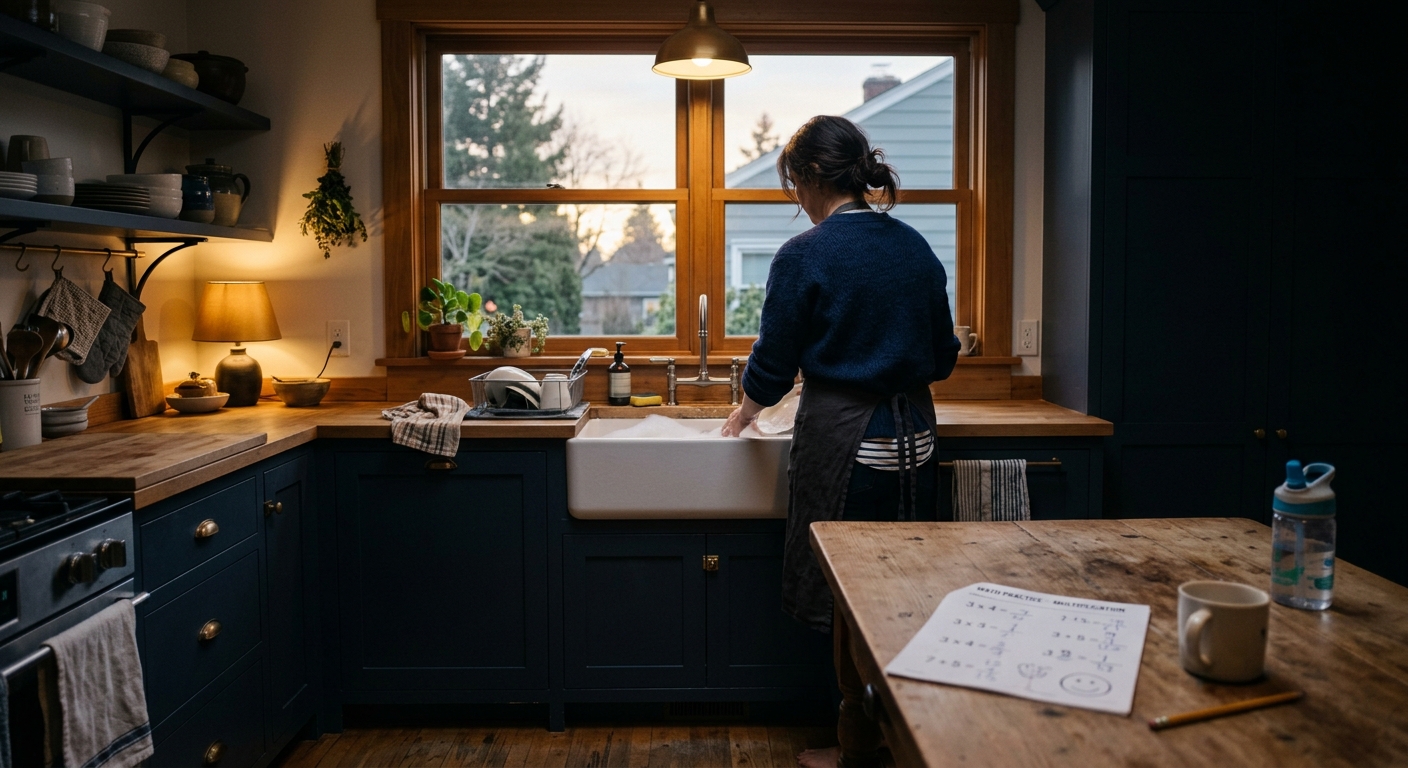
Episode 1 · August 5th, 2026
Loved First
The Mother Who Finally Stopped Earning It.
Dana has spent her whole life auditioning for love — as a daughter, a wife, a mother. One ordinary Tuesday night, her eight-year-old asked her a question that cracked the whole pattern open. This is her story, and the framework it revealed: Loved First, Built Second.
Listen now: Click image above.
I walk with you. Anchor God
Full Episode Transcript
"Loved First: The Mother Who Finally Stopped Earning It"
[INTRO]
Hey, welcome to Beyond Sight, the podcast where we talk about money, faith, family, and what it actually looks like to build something when the world wasn't designed for you to see it.
I'm Ashlee Richards. I'm an accredited financial educator and consultant, a woman living with autoimmune disease and progressive vision loss while raising five kids. I am a survivor of abuse in foster care. I walk with families who are breaking generational money cycles, not because they read a book about it, but because they're living it.
If you are new here, welcome. Pull up a chair. If you've been here, welcome back. I'm glad you stayed. Let's grow.
[THE HOOK]
It's 8:47 on a Tuesday, and my friend Dana is standing at her kitchen sink, hands in dishwater that's gone cold twenty minutes ago. Behind her, her daughter is having a full meltdown over a math worksheet, tears, crumpled paper, the whole thing.
And Dana does what Dana always does. She turns around, kneels down, and softens her voice. Fixes it. Makes it better. Because that's what a good mom does, right?
Then her daughter looks up at her, red-eyed, and asks the question that's going to follow Dana into next week: "Do I have to be perfect for you to love me?"
Dana told me she just stood there. Hands still wet. And for the first time in maybe her whole life, she didn't have an answer ready.
Today's episode isn't really about money. It's about the scorecard almost every one of us is carrying, and the night my friend Dana found out she'd been handing hers to her daughter, one gold star at a time.
I want to tell you the whole thing, not just the moment at the sink, but where the scorecard actually came from. Because I promise you, by the end of this, you're going to recognize your own copy of it.
[WHERE THE SCORECARD CAME FROM]
Dana and I have known each other for years. Long enough that she doesn't perform for me anymore, which is honestly rare. And over the years, one thing about her has never changed: she is the fixer. The one who remembers everyone's birthday. The one who shows up with the casserole before you even ask. The one who, in every group project since the fourth grade, ended up doing her part and two other people's parts, and never once said anything about it.
For a long time I just thought that was Dana being Dana. Generous. Capable. The friend everybody wants on their team. It took me years to understand that underneath all that capability was a little girl who learned, very early, that love in her house came with conditions.
Her parents weren't cruel. I want to be careful here, because this isn't a story about villains. Her dad worked constantly. Her mom ran a tight ship, grades, chores, church attendance, all of it tracked, all of it graded. And when Dana brought home an A, she got warmth. A hug. "That's my girl." When she brought home a B, she got a quieter house. Not punishment, exactly. Just, less. Less warmth. Less eye contact. Less "that's my girl."
Nobody sat Dana down and said, "Love here is conditional." Nobody has to say it out loud. Kids are the best data scientists on the planet. They run the experiment maybe four or five times, and after that, they know exactly what earns the warmth and what doesn't. And once you know the rules of a game like that, you don't stop playing it just because you grew up and moved out.
Dana just started playing it everywhere. At work, where she's the one who says yes to the project nobody else wants, because saying no feels risky, like the warmth is going to go away. At church, where she's on three committees she never actually agreed to join, she just showed up once and it became hers. And at home, in the most exhausting version of all: with her own kids, where she has quietly decided that being a good mother means never running out. Never needing anything. Never letting them see her tired, behind, or unsure.
If any part of that is landing a little too close for you right now, you're not alone. A lot of us are still running an audition we started as kids, just with different judges now. A parent. A spouse. A church committee. Our own kids. The stage changed. The performance didn't.
[THE TUESDAY NIGHT SCENE]
So, Tuesday night. Dana's in the kitchen after dinner, doing the thing she does every single night: dishes, lunches for tomorrow, half an ear on the TV, half an ear on the kids. Her daughter is at the table with a math worksheet — long division, the kind that comes home in third grade and ruins everyone's night.
And her daughter starts to unravel. Not dramatically at first, just frustrated, erasing too hard, tearing the paper a little. Dana hears it building behind her and does what she always does. Drops the sponge. Turns around. Kneels down at eye level. Softens her whole voice. "Okay, show me what you've got so far. We'll figure it out together."
But this time it doesn't land. Her daughter is already past the point where explanation helps — she's crying now, real crying, the kind that isn't about long division anymore. And in the middle of it, through the tears, she looks up at her mom and asks — and Dana repeats this to me word for word, because she says she'll never forget it, "Do I have to be perfect for you to love me?"
Dana said the question didn't even make sense to her at first. Because in her mind, she has never once told her daughter she has to be perfect. She tells her she's proud of her all the time. She tells her she loves her every single day, multiple times a day. So where did this question even come from?
But here's the thing about kids — they don't learn the rules of love from what you say. They learn it from what they watch. And what Dana's daughter had been watching for years was a mother who never rested until every task was finished. A mother whose voice tightened, just slightly, whenever something didn't go according to plan. A mother who, without ever saying the words "you have to be perfect," modeled a version of love that was constantly, quietly being earned.
Dana wasn't handing her daughter a lecture about perfectionism. She was handing her a demonstration of it. Every single day. And her daughter, who's eight and doesn't have the words for any of this yet, just felt the shape of it and asked the only question that made sense: is this what I have to do too?
[THE TURNING POINT]
Dana told me she didn't answer right away. She said she just knelt there on the kitchen floor, hands still wet from the sink, and something in her chest cracked open. Not in a dramatic, movie way. Quietly, like a window finally opening in a room that had been sealed shut a long time.
Because in that moment, she wasn't just looking at her daughter's face. She was looking at her own, twenty-five years earlier, at a different kitchen table, waiting to find out if a B-plus was going to cost her the warmth that night.
And she told me the thought that hit her wasn't guilt, exactly, or not only guilt. It was recognition. "Oh," she said. "I'm still auditioning. I never stopped. And now I'm teaching her to audition too."
Here's what I love about this part of Dana's story, and why I asked her if I could share it with you: she didn't spiral into shame. She didn't collapse into "I'm a terrible mother." What she felt, she told me, was more like clarity. A door she didn't know was locked, suddenly unlocked. Because if the pattern was learned, that means it can be unlearned. Not overnight. Not by force of will alone. But it's not a life sentence, it's a habit standing in a doorway, and habits can be walked back through.
So right there on the kitchen floor, with a half-finished math worksheet between them, Dana didn't try to fix the moment the way she fixes everything else. She didn't rush to reassure her daughter with a quick "of course not, sweetie!" and move on to finishing the homework. She sat with the question. She said, "That's such an important thing to ask me. Can I think about it for a second before I answer, because I want to tell you the truth?"
And in that pause, in choosing not to perform, but to actually find the true answer, Dana told me she felt something shift that had been stuck in her for three decades.
[THE TAKEAWAY — LOVED
FIRST, BUILT SECOND]
Here's what Dana eventually said to her daughter, once she'd actually found the true answer instead of the fast one: "No. You never have to be perfect for me to love you. I love you on your best day and your worst day and every regular Tuesday in between. And I need to tell you something, I think you've been watching me act like I have to earn love by never messing up. And that's not true for me either. I'm going to work on that. Will you help me?"
That last question, will you help me, might be my favorite part of this whole story. Because Dana didn't just correct her daughter's belief. She let her daughter see the belief get corrected in her, in real time. That's a different kind of teaching than any lecture could ever be.
This is the framework I've built my whole life's work around, and I want to give it to you plainly, because Dana's story is the truest illustration of it I know:
Loved First, Built Second.
Every cycle we break, with money, with parenting, with our own self-worth, has to break from the floor of love, not from striving. You cannot hand your child a security she's never seen you have yourself. You cannot teach financial peace from a place of frantic earning. And you cannot raise a child who believes she's loved unconditionally if the only love she's ever watched modeled is the conditional kind.
Built second doesn't mean building doesn't matter. Dana still wants her daughter to try hard, to do her homework, to grow into a capable, responsible woman. That building is real and it's good. It just can't come first. Love comes first. The floor gets poured before anyone starts putting up walls.
In the weeks after that Tuesday night, Dana told me she started doing something small but strange for her: she started letting things be unfinished. She left a load of laundry in the dryer overnight. She said no to a fourth committee. She told her daughter, out loud, "I'm going to rest for twenty minutes and it has nothing to do with anyone deserving it. I just need it." Small things. But she said her daughter started watching those moments too, and slowly, the audition started to lose its grip on both of them.
[MY OWN SCORECARD]
I'm not going to sit here and tell you I heard Dana's story and thought, "wow, how sad for her." I heard Dana's story and saw my own reflection in it so fast it knocked the wind out of me.
I grew up needing to earn my worth in ways I'm still, honestly, unlearning. And I'll be honest with you, building this business hasn't always helped. There's a version of me that still, on a hard week, measures whether I loved first that day by how much I got built. How many emails answered. How many episodes recorded. How functional I looked to everyone watching.
This is not toxic positivity, and I'm not going to pretend I've got this fully solved, because I haven't. But here's what I know for certain: my kids are watching my Tuesday nights too. Not my highlight reel. My actual, ordinary, cold-dishwater
Tuesday nights. And whatever they see me believe about earning love, they will quietly start to believe it too.
So this one isn't just Dana's episode. It's mine. And if you're still listening, it might be yours too.
[DISCUSSION]
So here's what I want to leave you with tonight, not a worksheet, not a to-do list. Just a question, the same one Dana had to sit with on her kitchen floor.
Where in your life are you still running the audition? Whose approval are you performing for tonight, a parent, a spouse, your own kids, even God, and what would it actually cost you to just stop, for one evening?
I'm not asking you to overhaul your whole life by tomorrow morning. I'm asking you to notice one moment this week where you're about to earn something that was never supposed to be earned in the first place, and see what happens if you set the audition down, just for that one moment.
If you want to sit with this longer, I'd love to hear where it lands for you. You can always reach me through the website. And if you know someone who needs to hear Dana's story tonight, someone still auditioning for love she already has, this might be the episode to send her.
[OUTRO]
That's what I've got for you today. If something landed, if one line made you stop and think, I want you to do one thing with it. Don't just agree with it.
Bring it home. Talk about it at the dinner table. Write it in the margin of whatever notebook is closest. Text it to the person who needs to hear it.
This is not content you consume. This is a conversation you continue. If you want to go deeper, everything I've got is at financiallygrowing.com.
The MoneyRoots Starter Kit, the Bridge Workbook, the curriculum, the coaching, it's all there. And the show notes for this episode are linked in the description below.
If this episode helped you, share it with one person, not for the algorithm, for them.
I walk with you.
Anchor God always. Tell God.

Episode 0 · July 29th, 2026
Why This Show Exists
Before I ever tell you about a friend, I need to tell you about a parking lot.
The morning my divorce papers were signed. The same week I found out my vision loss was permanent. A job lost just days before that.
Three losses, one month — and honestly, not even the hardest things I've survived.
Episode 0 of Beyond Sight: Money in the Dark is live, and it's the one story I couldn't skip. No friend today, just me, and the floor I had to build completely on my own, for the first time in my life.
This is where Loved First, Built Second actually came from.
Listen now: Click image above.
I walk with you. Anchor God
Full Episode Transcript
"Why This Show Exists"
Episode zero. Why this show exists.
[THE HOOK]
It's a Tuesday afternoon. And I'm sitting in a parking lot, engine off, hands still on the wheel. That morning I'd signed the last of my divorce paperwork.
That same week, a doctor told me my vision loss was permanent and progressive, not going to reverse. And an email had landed a few days before that, the kind that starts with, "we regret to inform you."
My marriage. My eyesight. My job. All in the same handful of weeks. And I want to be honest with you, none of those were the first hard thing that had ever happened to me. Not even close. But sitting in that parking lot, I remember thinking: I don't think I have ever had a floor under me. Not once. Not really.
That thought is the whole reason this show exists.
[PERMANENT INTRO]
Hey, welcome to Beyond Sight, the podcast where we talk about money, faith, family, and what it actually looks like to build something when the world wasn't designed for you to see it.
I'm Ashlee Richards. I'm an accredited financial educator and consultant, a woman living with autoimmune disease and progressive vision loss while raising five kids. I am a survivor of abuse in foster care. I walk with families who are breaking generational money cycles, not because they read a book about it, but because they're living it.
If you are new here, welcome. Pull up a chair. If you've been here, welcome back. I'm glad you stayed. Let's grow.
[BEFORE THE PARKING LOT]
I'm not going to tell you every detail of this part, and I want to be upfront about that, because some of it isn't just mine to tell in detail. It involves other people. And some of it I'm still not ready to say out loud in full. But I can't tell you why this show exists without telling you the shape of it.
I had a childhood I had to survive. That's the truest, simplest way I know how to say it. Home wasn't always safe. I learned very early how to read a room before I walked into it, whether it was going to be a calm night or a hard one. That's not a skill an eight-year-old should have to build. But I built it, because I needed it.
And then, later, my first marriage. I'm not going to walk you through the specifics of that either, but I'll tell you plainly, it wasn't safe there either. Not in the way a marriage is supposed to be safe. I carried the same skill I'd learned as a kid right into that house. Reading the room. Staying small enough not to cause a problem. Managing everyone else's peace at the expense of my own.
So by the time I got to that parking lot, the vision loss, the job, the divorce finally final, I want you to understand: those weren't the first losses of my life. They were just the ones that finally happened all at once, with nothing underneath to catch me, because I had never actually had a floor. I had survived. I had adapted. I had never once had the chance to just rest on something solid.
[THE SCENE — THE PARKING LOT]
So, that Tuesday. I'd signed the divorce papers that morning. Not a dramatic scene, a courthouse, a pen, a clerk who barely looked up. It was almost anticlimactic, which somehow made it worse. Years of a marriage that wasn't safe, reduced to a signature and a stamp.
That same week, an ophthalmologist told me my vision loss wasn't going to stabilize. Progressive. Permanent. And a few days before that, an email, the kind that starts with "we regret to inform you" and ends with your access badge getting deactivated by five o'clock.
I drove to a parking lot after all of it caught up to me at once, turned the engine off, and just sat there. And I started doing the same kind of frantic, present-tense math I think a lot of us do in that moment. How am I going to support myself and my children? How long until I can't read a printed bill anymore? What does it even mean to start over completely — with no marriage, no job, three kids, and a body that's starting to fail me too.
I cried in that parking lot for a long time. Not because any one of those three things was, by itself, the worst thing that had ever happened to me, I'd survived worse, quietly, for years. It was that for the first time, there was no reason left to keep managing everyone else's peace. The marriage that had needed managing was over. There was nothing left to hold together except myself, for my children.
[TURNING POINT]
Here's what I want you to understand about this next part: nobody showed up to rescue me. There was no partner at a kitchen table telling me it was going to be okay. It was just me, in that parking lot, and then me, deciding what happens next. And I think that's actually the most important part of this whole story.
Because for the first time in my life, the floor I'd never had wasn't going to come from managing somebody else's moods, or surviving somebody else's choices. If it was going to exist at all, I was going to have to build it myself, starting with letting myself be loved, by God, and by myself, before I built one single practical thing on top of that.
So that's what I did. Slowly, and not gracefully. I went back to school. Multiple certifications in accounting and business, not because I had some grand five-year plan, but because for the first time, I got to choose something just because it was mine to choose. Nobody's peace to manage. Nobody's room to read. Just a decision, made by me, for me.
That's the turning point. Not a rescue. A rebuild, one I started completely on my own, from a floor I had to pour myself, for the first time in my life.
[THE TAKEAWAY]
So I built four frameworks. And the first one, the one everything else stands on, came directly out of that season: Loved First, Built Second. I could not build a single stable thing in my life until I let myself be loved first, by God, and, for the first time, by myself. Not earned. Not managed for. Just received. Everything else, the certifications, the career, eventually this business, got built second, on top of that.
Vision Before Sight came from the same season, because my actual eyesight was leaving, and the only thing that didn't leave with it was a clear sense of what I still wanted my life to be. And the Hidden Truth in the Diagnosis — because grief and a strange kind of relief showed up together that year, and nobody had ever told me that was allowed to be true at the same time.
And here's why this show tells stories instead of teaching lessons: because sitting in that parking lot, I didn't need a worksheet. I needed to know someone else had built a floor from nothing and made it to the other side. That's what I'm trying to be for you. Not your instructor. Your proof that the other side exists.
[WHAT'S COMING]
So here's what's ahead. Over the next several weeks, I'm going to introduce you to some friends of mine.
Dana, who spent her whole life auditioning for love, until her own daughter asked her a question that cracked it open.
Tasha, whose brilliant son could write a ten-page paper on the Treaty of Versailles and still couldn't read a bank statement.
Carol, who lost her sight and very nearly lost her independence right along with it. And Mark and Julie, who almost let a business quietly cost them a marriage.
And somewhere down the road, I'll tell you the rest of my own story too, including how I ended up on a dragon boat, of all places, and met the man who'd eventually become my second husband, and the one who taught me that marriage could be the safe thing I never had. That's a story for another day.
Today was about the floor that had to get built before any of that could happen.
If any part of my story today felt familiar, if you've ever had to build your own floor from nothing, with nobody coming to build it for you, I want you to know two things. You are not the only one this has ever happened to. And you don't have to have it figured out before you're allowed to start. I didn't. Hit follow or subscribe wherever you're listening, so the next story finds you when it lands.
[PERMANENT OUTRO]
That's what I've got for you today. If something landed, if one line made you stop and think, I want you to do one thing with it. Don't just agree with it.
Bring it home. Talk about it at the dinner table. Write it in the margin of whatever notebook is closest. Text it to the person who needs to hear it.
This is not content you consume. This is a conversation you continue. If you want to go deeper, everything I've got is at financiallygrowing.com.
The MoneyRoots Starter Kit, the Bridge Workbook, the curriculum, the coaching, it's all there. And the show notes for this episode are linked in the description below.
If this episode helped you, share it with one person, not for the algorithm, for them.
I walk with you.
Anchor God always. Tell God.
Transcripts are published in full for every episode. If a transcript hasn't appeared yet, it's coming within a day of air, and if it reads wrong on your setup, tell us on the and it goes to the top of the pile.
If an Episode Met You
The show is free. So is the first step after it.
For her: the free Walk With Me guide, a first walk toward the floor the show keeps talking about.
For your family: a free sample lesson you can teach Monday.
Subscribe on Spotify so the next episode finds you:
Loved first. Built second. Financially growing. · Cheers and spreadsheets.

Financially Growing is a prevention-first financial wellness company that walks with women, teens, and families, built on one conviction: you are loved first and built second.
- Cheers and spreadsheets.


Faith integration is always optional and clearly marked; core money skills are fully accessible to every family. Colossians 4:6 referenced.
Copyright © 2026 - Financially Growing LLC · Portland, OR - All Rights Reserved | Built accessible - WCAG 2.2 AA+